Paraeducators’ Experience Project
We know that paraeducators often serve as key supports for middle school readers and writers who struggle with typical curricula and classrooms. And yet, paraeducators are virtually absent in the research literature, and their work is often under-recognized and under-funded within school environments. In this project co-developed by Bethany Silva, Ruth Wharton-McDonald, and me, we have been working to develop a team of researchers and paraeducators, conduct a landscape analysis throughout our state, and map potential ways to effect change in systems that have historically left paras without enough stability and knowledge to do their work effectively.
Through funding from our Spencer Foundation Vision Grant, we have built a team, created a survey, and conducted focus groups in order to better understand paras’ experiences through the eyes of K12 school administrators, educators, and paraeducators themselves. Ultimately, our goals are to better sustain paraeducators who are working in the field and to learn more about possible paths to increase paras’ impact so that school systems can achieve more just outcomes for vulnerable students.
National Day on Writing Research
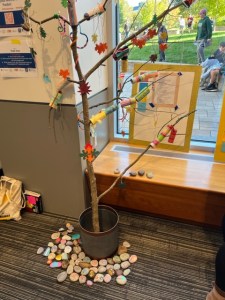 The National Day on Writing is a writing holiday that was established in 2009 by the National Council of Teachers of English to celebrate writing and composition across genres, forms, and modes. In 2019, Bethany Silva and I began to co-design and host a Writing Celebration in collaboration with several writing organizations across our university campus. We focus on playful writing opportunities like creating a “Poet-tree” from participants’ poems and illustrations (and a large tree branch), character-creation prompts, and blackout poetry. Since then, we have hosted this event both in-person and online during COVID-19 remote instruction. Sometimes attendees have included only a small circle of university participants, and sometimes — thanks to a small grant from UNH’s Center for Humanities — we have invited students and teachers from our local middle school.
Along with undergrad and Masters’ level research assistants (Maya Ashooh and Blake Bolduc), we’ve become curious about how our participants perceive the event and what they learn from it. We have begun to study these questions through a regular program evaluation distributed to student and faculty attendees. We are particularly interested in participants’ views of playful, joyful, fun writing events like this — and whether or not they help to shift participants’ perceptions of writing.
Products —
- 2024: Ashooh, M., Magnifico, A.M., & Silva, B.A. “I’m going to teach differently”: Changing perceptions of writing instruction through digital text creation. In S. Kersten and C. Ludwig (Eds.), Born-Digital Texts in English Language Teaching, Multilingual Matters.
Transformational Inquiry in Literacy and Digital Environments (TILDE) during COVID-19
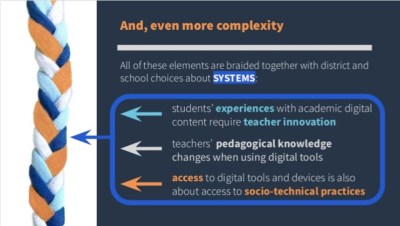 How do students and teachers understand digital literacies? How do we teach and learn in digital spaces, and how have these understandings shifted with the onset of COVID-19 remote learning? These are the questions that were at the root of the TILDE project.
Even before COVID-19, New Hampshire and many other states had begin to implement standards addressing the importance of teaching digital literacies. The onset of the pandemic, however, forced districts to quickly implement remote learning. This rapid shift to digital tools and teaching methods revealed uneven access to, resources for, and knowledge of digital literacies — factors that limited educational opportunity for many students.
In response, the TILDE project looked across K16 education to investigate how K12 and college educators transitioned to remote learning, and how they have been using its tools since. With the support of a UNH CoRE pilot research grant, Bethany Silva and I recruited an amazing K16 practitioner inquiry team. We co-designed and piloted surveys and focus group protocols that examined relationships among digital tools, remote learning, literacy curricula, and educational systems. We have collaboratively reviewed and analyzed the resulting data and developed digital literacies recommendations for state policy and teachers’ professional learning. Through this project, we want to better understand and implement classroom digital literacies.
Products —
- May 2020: UNH CoRE COVID-19 project abstracts
- April 2021: Transformational Inquiry in Literacy & Digital Environments During COVID-19 (download PDF of invited talk for UNH COVID-19 Response Task Force)
- November, 2021: Collectively Examining Digital Literacies Teaching and Learning (youtube trailer for our 2021 National Council of Teachers of English Annual Convention session)
- April, 2022: TILDE Fireside Chat, a Youtube discussion for our school partners that summarized our project & research
School-University Dialogues Project
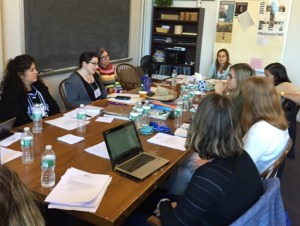
School administrators, teachers, and parents are deeply concerned about the college-readiness of students, particularly in writing. Yet, definitions for “college-readiness” have often been dictated by corporate interests and assessment groups — not by teachers, schools, or universities. Furthermore, English teachers in secondary schools have limited opportunities to witness college writing expectations, while college-level teachers can rarely gain access to the high school writing contexts with which their students are familiar. Christina Ortmeier-Hooper and I worked with a group of writing teachers across institutions to build an affinity space that bridges this gap. The Dialogues brought high school and college writing teachers together to study how we prepare students for the analytical, expository, persuasive, and creative writing that is necessary for college-level academic study. Together with our participating teachers, we presented a public action-research colloquium at UNH on September 16, 2016 (“Traditions, Transitions, and Transformations: Student Writing and College-Readiness”). Later on, we took this research to the NCTE Annual Convention. You can read more about our work in this UNH Magazine feature about collaborations with local schools, or in our paper in the ICLS 2018 conference proceedings.
 Affinity Spaces & Qualitative Methods for Studying Online Spaces
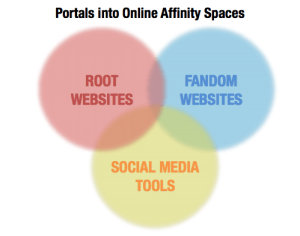
Little research documents the content that young people create and share in online social networking forums — virtual worlds, art communities, fanfiction archives, role playing sites, and the like. My work on adolescents’ multimodal writing in Neopets agrees with this assertion: Games like Neopets, book- or media-based fandoms, and art- or fiction-based forums are not well-understood. Many of these affinity spaces stretch across several sites and are loosely connected by features like hyperlinks or twitter hashtags. But how can we study engagement in these spaces when members’ activities are diverse, multi-sited, self-directed, collaborative, and blended across online and offline sites? Jen Scott Curwood, Jayne Lammers, and I write about extending qualitative methods to examine the complex conversations, texts, and artifacts that travel through affinity spaces as members work and learn together, drafting and revising their ideas.
 Assess-As-You-Go: Online Writing and Peer Response
During my postdoc, I worked with the Assess as You Go and Scholar teams (here is a high-level overview of these projects) to build and implement new online tools to enable multimodal writing and peer response in classrooms. Designing and testing Scholar allowed us to see the openings and limitations that new tools may provide for teachers. I worked with teachers to create a space for Scholar in their classrooms, design formative assessments that encourage peer review, and understand how students and teachers interact in and around this technology. Becca Woodard, Sarah McCarthey, and I recently published “Teachers as co-authors of student writing: How teachers’ initiating texts influence response and revision” in Computers and Composition. This piece details how students in three classrooms responded to each others’ writing using Scholar, and what role teachers’ initiating texts (assignments, rubrics, etc) played in setting up this classroom discourse.
 Bidirectional Artifact Analysis: Methods for Examining Creative Processes
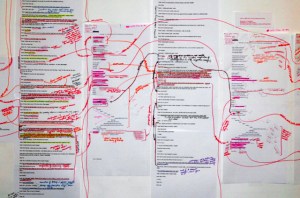
In creative writing and arts environments, peer and mentor response are central to young artists’ work. In these spaces, ideas, drafts, and revisions often become collaborative and multivocal over time, and a final artifact rarely reveals the process of its development. Because I want to understand the complex ways in which writers and readers (and artists and critics) work together, new methods have become necessary. Erica Halverson and I have begun to develop bidirectional artifact analysis, a technique that brings together a variety of data types and qualitative analytic methods to allow researchers to map and articulate relationships between creative processes and products. While typical descriptive analyses move forward, we have found that moving bidirectionally — from final product backward and from initial idea forward — helps us trace participants’ learning through artifacts, reflections, critiques, and revisions.
 Writing for Whom?: Audience and Creative Writing
The increasing influence of social media and technologies for writing have led to rapid evolution in young people’s writing and written collaborations. My dissertation examines such changes by looking at the confluence of writing, available audiences, participant structures, and motivations to write. I did so by spending time with young writers in three settings: an 11th grade English classroom, a creative writing camp, and the online game Neopets. This case study design holds creative writing practice constant across the contexts in order to better understand what happens when writers stand “among” different audiences (Lunsford & Ede, 2009) — mentors or teachers, peers, and public audiences. Using several qualitative analytical techniques, the study explores how available audience(s) and feedback from readers in each setting affect writers’ individual and social understandings of their writing and of themselves as writers.
 Barrel of Monkeys: Creative Arts Ethnography
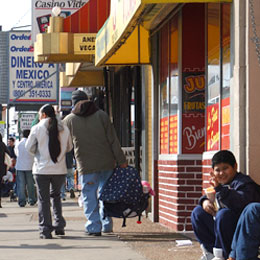
Even while participation in creative endeavors like arts education is seen as abstractly beneficial, these programs are rarely connected to accepted measures of progress, like writing proficiency or standardized testing scores. In this 2008 study, I spent six weeks in an urban (90% low-income) neighborhood school that partners with Barrel of Monkeys (BOM), a Chicago theatre troupe, for a residency in its fourth grade classrooms. BOM actor-educators teach creative writing and improvisation workshops and work with students to craft several stories. At the residency’s conclusion, actors perform short plays adapted from these stories, thus legitimizing the students as authors and playwrights. To document what students, teachers, and BOM members perceived as benefits of this experience, I (1) observed each of the actor-educators’ planning sessions, teacher planning sessions, and in-school residency days; (2) collected student story artifacts; and (3) interviewed the actor-educators, classroom teachers, and school principal.
 Journalism.net: Epistemic Game
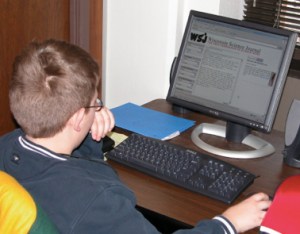
My masters thesis, Writing Beyond the Curriculum, examined a technology-supported, epistemic role-playing-game called Journalism.net in which students became local reporters. They learned about local issues, interviewed experts, drafted stories, and published their work online. Along with several members of the Epistemic Games Group, I designed, ran, and collected data on this game in several different versions and under several different mastheads from 2004-2006. Initially, middle school students in UW-Madison Education Outreach programs used Byline publishing technology to become science reporters in a version called Science.Net. Rising 7th-9th graders published the Wisconsin Science Journal in partnership with the UW-Madison PEOPLE program. Finally, we collaborated with a journalism graduate student to develop a version of the game that focused on community issues in South Madison and published under the South Madison Times masthead.
 Alecia Marie Magnifico